
Launching a new product when it comes to business is exciting but could also be risky. In fact, many startups and enterprise innovations fail not because the idea was bad, but because it was built in isolation from real users. To discover the actual needs of their customers, many businesses often invest months and sometimes years in developing feature-rich products. This is exactly where the concept of a Minimum Viable Product (MVP) changes the game.
The intentional development of the idea to validate the need and requirements is the MVP approach. MVP, the simplest version, is released before the detailed product that delivers real value and allows businesses to test assumptions, gather feedback and validate demand before committing significant time and resources.
In today’s hyper-competitive digital landscape, companies that embrace mvp in software development reduce uncertainty, minimize financial risk and increase their chances of building products that customers truly love.
So why is MVP development considered essential for minimizing failure risk? Let’s find out in this blog.
If you are ready to build your first Software MVP, then contact us today and let’s get started!
What is MVP in Software Development?
Without taking unnecessary risks, MVP software development offers a smart and strategic way to turn ideas into successful products. By focusing on building the product with the essential features, a Minimum Viable Product makes it valuable while ensuring the core problem is solved effectively.
An MVP, as opposed to a wireframe or a basic proof of concept, is a functional version that has been made available to real users without extraneous complications. Businesses can take advantage of MVP development by testing functionality, getting input from the real world and providing a solid basis for future upgrades by starting with the fundamentals. This approach of mvp software development lowers the probability of failure while also saving time and development costs. Companies ensure that their solution fulfills market demands by continuously constructing, measuring, and learning based on customer data.
Making software for your business is not just about launching the product but the right one that gives your business a strategic and strong foundation to thrive in the competitive landscape.
How MVP Development Helps You Achieve Business Goals Faster
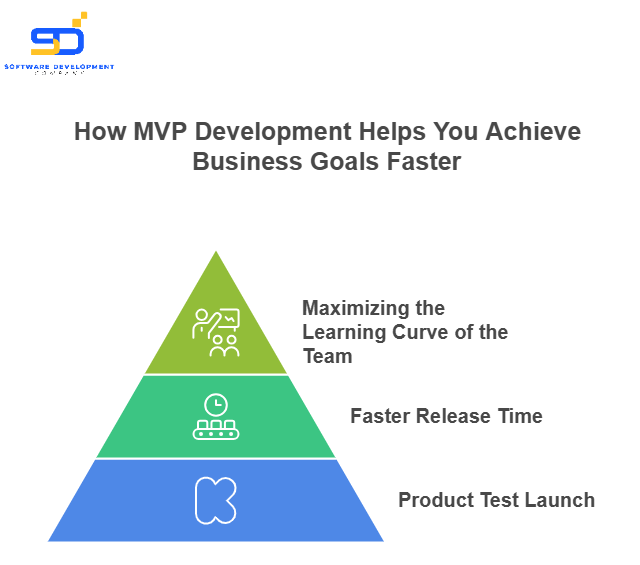
Now that we have a clear understanding of MVP in software development, let’s explore how it directly supports your business goals and why launching one can be a game-changing move.
Product Test Launch
The team remains focused on the essential features and worth of the software and product when you start with a minimum viable product. This method repeatedly lowers costs and eliminates risks and errors. You can develop a viable business idea that will be profitable with the help of the product analysis and feedback.
In other words, you need little to no resources to hypothesize the product. By avoiding extraneous features and maintaining clarity and crispness, it prevents your staff from procrastinating.
Employing MVP software development services reduces rework by simplifying the process of identifying and resolving issues and errors. On the other hand, software with multiple layers of functionality can be challenging and time-consuming because finding and fixing faults frequently causes deadline delays.
Faster Release Time
Testing the waters before diving in is always advantageous. When it comes to MVP design, the principles are still the same. Only when the main element of your product is successfully launched can you release it more quickly.
MVP software development companies enable you to begin establishing a rapport with your target audience and expedite the product’s release. This could serve as a solid foundation for future success.
Early market testing ensures that there is real demand for your product or service, preventing costly errors. This is precisely what MVP does.
Maximizing the Learning Curve of Team
From the basic launch of the product until full-fledged delivery, the product evolves with time in terms of features and technical aspects. This, in turn, provides many opportunities for the development team to learn the product in depth, thus adding the best techniques and technical factors that will enhance the product.
MVP is an iterative process, as was previously noted. It offers the team a platform to learn and adopt iterative processes like Agile, increasing the team’s learning curve.
MVP vs PoC vs Prototype
Although terminology like MVP, PoC, and prototype are sometimes used interchangeably when creating new products, they have rather different functions. Understanding these phrases highly impacts the selection of the strategy at the right stage of development while saving time, money, and effort.
1. Proof of Concept (PoC)
To know if the concept is technically possible, a Proof of Concept (PoC) is created. The most important topic that is addressed via the PoC is the possibility of building a specific requirement. A proof of concept is an experimental viable product which is kept confidential and solely concerned with confirming a concept’s technical feasibility. This could include the concern if a certain technology, integration, or algorithm will function as planned or not.
2. Prototype
An interactive model of the product that shows how the collection of your requirements will look and function. And how will this product work and feel? Prototypes are constructed to demonstrate the design, user flow and user experience. They are considered to be a completely functional product that is primarily used for stakeholder feedback and design validation.
3. Minimum Viable Product (MVP)
The first working version of a product that is made available to actual consumers with just the essential features required to address the main issue is called a Minimum Viable Product (MVP). It validates the question, which is, should we build this product? Unlike a PoC and Prototype, an MVP app design is focused on gathering real customer feedback which allows businesses to validate demand, reduce risk and improve the product through iterative development.
|
Aspect |
PoC | Prototype |
MVP |
| Purpose | Test technical feasibility | Demonstrate design & usability | Validate market demand |
| Audience | Internal team | Stakeholders/test users | Real customers |
| Functionality | Limited, experimental | Simulated | Fully functional (core features only) |
| Stage | Idea validation | Design validation | Market validation |
Steps Involved In Building An MVP Faster
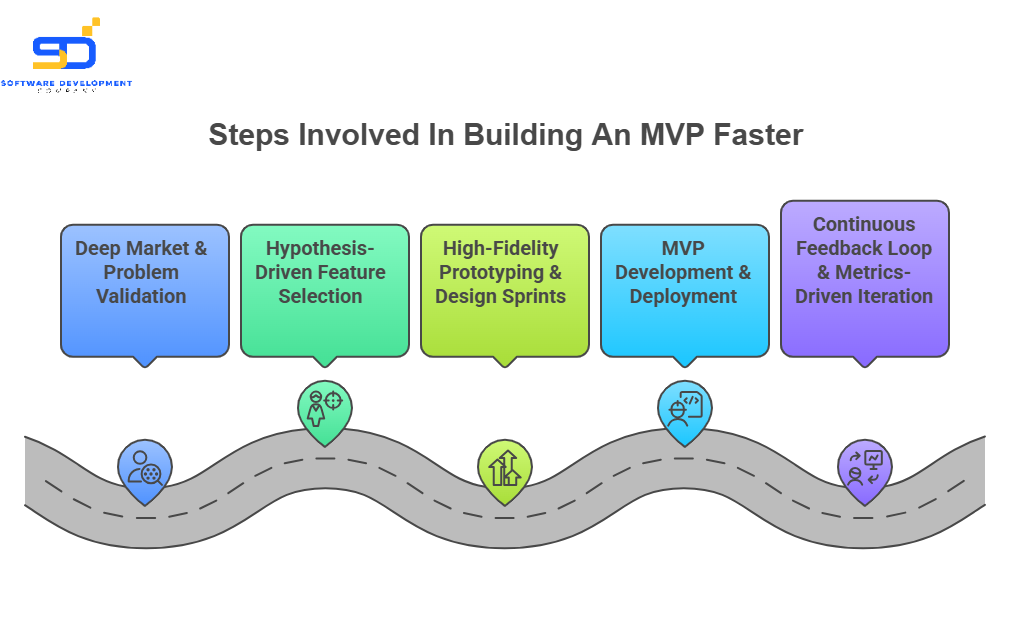
While depending on the complexity, novelty of the software and other factors, including the type of MVP, a certain period of steps to build an MVP and time is required. While focusing on the core features, testing with real users and alteration based on feedback, software companies are focusing on MVP development for enterprises and follow a structured approach to ensure each MVP delivers maximum value efficiently and cost-effectively.
-
Deep Market & Problem Validation
Before hopping into the custom MVP software development, start by conducting thorough market research to understand ongoing market trends, competitors and pricing models. By doing so, a real gap or the missing piece is addressed. Moreover, to confirm and validate the product, thorough interviews, surveys and landing page tests with the potential users can be performed. Now establish objectives to direct development and assess whether your MVP has the desired effect by defining explicitly what includes activation rate, retention, and conversion.
-
Hypothesis-Driven Feature Selection
Frame your MVP around core hypotheses which are “what if we deliver this feature, how user behavior will allow to follow it” and prioritize features and functionalities using frameworks like RICE (Reach, Impact, Confidence, Effort) or MoSCoW (Must-have, Should-have, Could-have, Won’t-have). Ensure to keep the MVP simple and lean to avoid technical difficulties during the design phase of the architecture that allows for future scalability and growth.
-
High-Fidelity Prototyping & Design Sprints
Develop a mvp app design that is not only interactive but also simple and easy to simulate the product experience before coding, run design sprints to rapidly alter it if needed and test usability and ensure that all UX decisions are backed by data or research rather than assumptions.
-
MVP Development & Deployment
Use development cycles with 1–2 week sprints by implementing core functionality while integrating analytics hooks like event tracking and funnels. Then deploy the MVP early on a real platform, whether web or mobile, to gather authentic user feedback
-
Continuous Feedback Loop & Metrics-Driven Iteration
To know if the product idea of your business is useful for the targeted audience, collect quantitative data by analytics, retention and engagement, as well as qualitative information from user interviews and NPS scores. Plan effectively for product-market fit milestones including retention thresholds, virality and monetization validation, and adjust features based on these verified metrics.
Benefits of MVP in Software Development
Launch Quickly with Minimal Investment
With minimal yet viable and valuable functionalities, MVP is about launching a product. Any hurdle, failures or problems that come in the way can easily be eliminated and corrected without any loss. To assess the viability of their product or service while keeping costs under control, businesses can collaborate with the right software development company.
Identify and Engage the Right Audience Early
Identifying the ideal target market for your business or product is the main goal of the MVP concept. With an MVP, you can collect suggestions, conduct surveys, and get feedback, depending on time and expertise. By collaborating with MVP software development organizations, businesses can also conduct surveys, get feedback, and get insightful information about their users.
You may test the product and eliminate the hypothesis theory by having a clear understanding of the target market and the suitability of the offerings. With this knowledge, iterations will have fewer mistakes, reducing risk and accelerating the development process.
Ensures Alignment of Product Features with Real User Needs
Finding out later that we are producing something that no one wants is a nightmare. As a result, creating a workable product becomes essential. An MVP software design should be used early on to determine whether the product is viable. It is simpler to strike a balance between the product’s offerings and the needs of end users when the needs of the customers are identified.
To balance the demands and services, it’s critical to collect feedback of the highest caliber. With MVP, you may focus on a certain user base to receive insightful comments and answers.
Faster Time to Market
Businesses can enter the market more rapidly with an MVP than with a fully-featured product that takes months or years to develop. MVP software development services give businesses a competitive edge by releasing a working product, gaining information from real-world use, and iterating accordingly.
This method focuses on just useful functionality and lowers the chance of creating extraneous features. Before a full-scale launch, companies can improve their service and gain the trust of customers by testing an early version with actual consumers. Software development MVPs guarantee that businesses can test their ideas before moving on with full-scale production.
Improved Investor Confidence
A proposal with market validation is more likely to be supported by investors. An MVP makes obtaining funding simpler by offering concrete evidence of product demand and proving genuine user engagement. Presenting statistics from actual users allows businesses to highlight adoption rates, client engagement, and projected income.
This increases the likelihood of strategic alliances by strengthening the case for additional investment. With an MVP for software development, companies may ensure a scalable path for future expansion while customizing their product to satisfy the expectations of the investors.
Minimized Development Costs
It can be dangerous to invest in a product before it has been validated by the market. Businesses can save upfront expenses, distribute resources effectively, and build only the most critical features before expanding by collaborating with MVP startup software development professionals. This economic strategy avoids squandering money on features that aren’t necessary and might not be appreciated by people.
Additionally, depending on customer demand, it enables companies to reinvest savings into marketing, growing, or additional feature developments. Budget planning heavily relies on the cost of MVP software development, which helps companies save costs while guaranteeing a workable and marketable result.
Scalability & Future Growth
Software development MVP establishes the foundation for scalable solutions. Businesses can ensure long-term market relevance by starting with a lean product and progressively integrating additional features and utilizing new technology as they become available.
Minimum viable product software development facilitates the introduction of incremental upgrades without interfering with core functioning as user needs change. MVP software development services provide ongoing optimization and feature additions based on user feedback, helping firms future-proof their products.
If you’re looking to develop a fully functional MVP app, then hire our top software developers to make sure your app stands a chance in the market!
Final Thoughts
By introducing a basic, working product to assess actual customer demands before making significant investments, an MVP helps firms lower risk. This strategy assures that the product actually answers consumer problems, reduces expenses, increases investor trust, and expedites time to market. In the end, MVP development is a clever, effective method of reducing failure and transforming concepts into profitable, scalable products.
Frequently Asked Questions
Q: What is an MVP in software development
A minimum viable product is the first functional version of a product that includes only the essential features needed to solve the core problem. It allows businesses to test assumptions, gather real user feedback, and validate market demand before investing in full-scale MVP software development.
Q: How does an MVP reduce the risk of product failure
By releasing a simple, functional version early, businesses can validate real customer needs, test key hypotheses, and make improvements based on actual user behavior. This minimizes financial risk, avoids building unwanted features, and increases the chances of product-market fit.
Q: How is an MVP different from a Prototype or Proof of Concept (PoC)?
- PoC: Tests technical feasibility internally.
- Prototype: Demonstrates design, user flow, and usability for stakeholders.
- MVP: Fully functional product for real customers to validate market demand and gather feedback.
Q: What are the key benefits of developing an MVP
An MVP in software development helps businesses launch quickly, minimize costs, validate market demand, collect early user feedback, improve investor confidence, and create a scalable foundation for future growth.
Q: What steps are involved in building an MVP effectively?
Key steps to build an MVP include market and problem validation, hypothesis-driven feature selection, high-fidelity prototyping, development and deployment, and a continuous feedback loop with metrics-driven iteration to refine and improve the product.