
Every startup begins with an idea, a spark, but the moment is created when clarity meets a bold idea. In the fast-paced digital world, startups fight for attention and move fast, which could be risky, but without a strategy or plan, it could become a disaster.
Well-planned and executed businesses like Uber and Airbnb develop user-focused software solutions that address actual issues at scale and not just concepts. The success of these known companies is not accidental, but driven by intentional product development, smart technology choices, and revenue from business models designed from the ground up.
Before you jump directly into the plan execution, the idea should be clear about the benefits you will get from the product, because it is not just about writing code. The investment of time, effort and money is all about. There are reasons why businesses prefer the development of the software; here are a few of them:
- Validating market demand before investing heavily
- Building lean products that solve one problem extremely well
- Designing systems that can scale with growth
- Embedding monetization into the product experience
- Iterating based on real user data
How a startup tackles strategically can frequently determine whether it succeeds or fails. Overbuilding wastes valuable resources, underplanning limits growth, and building without specific business goals results in squandered potential.
Software changes from a basic product to an asset that helps in generating high revenue when coordinated with revenue objectives from the beginning. In this article, we’ll look at how companies can use lean development techniques, astute technological choices, and scalable monetization tactics to transform undeveloped business business ideas into lucrative digital solutions that promote long-term growth.
Startup vs Enterprise Software Development
Writing a few lines of code is not the only thing involved in software development but different companies have different requirements for how products are developed, and knowing these distinctions can help you succeed.
For startup businesses, the software development industry is a whole new world. To survive and establish a reputation, startups are primarily concerned with moving quickly, testing quickly, and putting speed ahead of perfection.
Their primary goal is to create a product that meets market standards and to validate whether the idea is exactly the solution to your users’ problem. But with the help of a Minimum Viable Product (MVP), it has become easier for startups to test an idea and make continuous changes to the product based on feedback from real users.
Moreover, any potential obstacles such as limited budget, a small workforce and the requirement that each item directly assist growth or revenue, comes in the way can be tackled easily.
On the other hand, established businesses and enterprises are aware of the software development world, therefore they focus on stability, compliance and long-term optimization. Their systems must integrate with existing infrastructure and support thousands of users without failure by typically establishing processes by considering monetization strategies of multiple stakeholders with layered approvals and strict security requirements.
To have a clear structure for the Startup vs Enterprise Software Development, we have listed down some key differences in a tabular form:
| Aspect | Startup Software Development | Enterprise Software Development |
| Primary Goal | Achieve product-market fit and generate early revenue | Maintain stability, scalability, and long-term efficiency |
| Speed of Development | Fast-paced, rapid iterations, quick releases | Slower, structured releases with extensive testing |
| Decision-Making | Founder-led, quick decisions, minimal approvals | Multiple stakeholders, layered approvals, formal governance |
| Budget & Resources | Limited budget, lean teams, resource-conscious | Larger budgets, specialized teams, dedicated departments |
| Team Structure | Developers wear multiple hats (Dev, QA, DevOps) | Clearly defined roles (architects, QA, security, compliance, DevOps) |
| Risk Tolerance | High risk tolerance, experimentation encouraged | Low risk tolerance, focus on compliance and risk management |
| Technology Choices | Flexible, often modern stacks for speed and agility | Proven, stable technologies with long-term vendor support |
| Scalability Focus | Basic scalability with room to evolve | Built for large-scale performance from the start |
| Documentation | Lightweight documentation, agile workflows | Extensive documentation, strict processes |
| Innovation vs Optimization | Focus on disruptive innovation | Focus on optimization, integration, and system reliability |
To put it simply, businesses highlight stability, structure and scalability, whereas startups favor speed, flexibility, and innovation. The most successful businesses learn to concentrate on architectural and functional disciplines and seek user validation in order to develop quickly and remain competitive in the digital market.
Having said that, let’s move forward to the key aspects that might stress the startups but are essential to have a successful platform for the business.
What Should Be The Design Focus of Your Software?
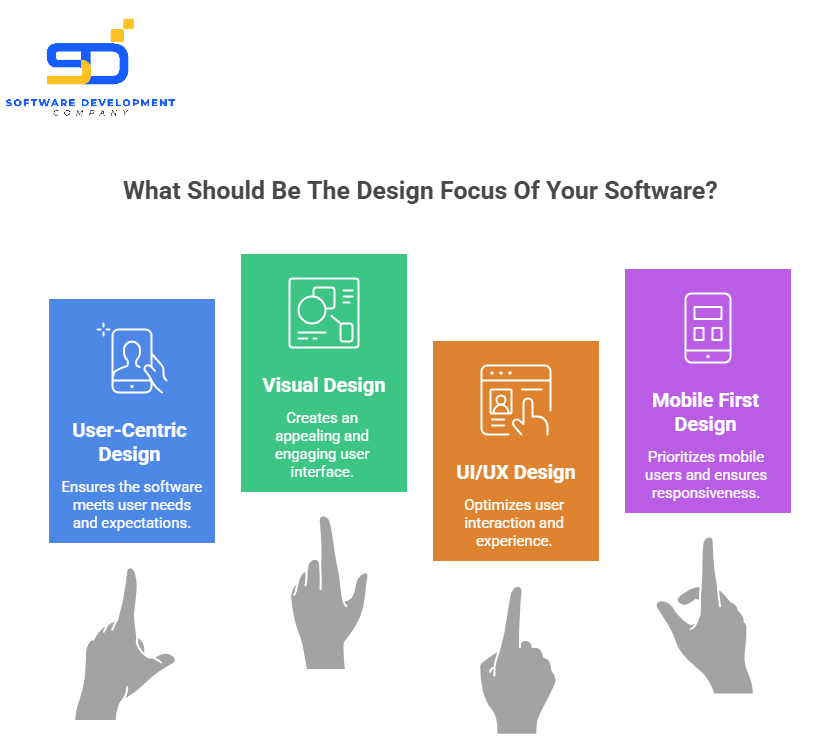
It’s not just about focusing on the functionalities and performance, though these are crucial to bring a skyrocketing success to your business. But the other things that grab audiences are attention and an intuitive layout, which is considered to be the simplest and most effective way possible. Whether you’re building an MVP to validate your startup idea or scaling a full-fledged platform to stay competitive in the digital landscape, your software’s design isn’t just about how it looks; it focuses on these points without you knowing
- It shapes how users experience it
- how quickly they adopt it
- generate real revenue
Key Software Design Priorities
-
Start by creating user-centric design
User-centered design (UCD) is the first and most crucial app design principle. This allows design by considering requirements with the wants, objectives and difficulties of the user in mind. The ultimate objective is to make sure that your program facilitates users’ ability to accomplish their goals with the least amount of work.
- User Research: Learn about the problems, issues and expectations of your targeted audience along with their requirements in this step. You can simply arrange interviews, use focus groups, or conduct surveys as well. This will guide you about the behaviour and pain points of the user with every element of your design.
- User Personas: Create thorough user personas using the study as a guide. These are made-up depictions of your intended market that can influence design choices. Important information like age, occupation, objectives and difficulties should be highlighted in each persona
- Usability Testing: Test a design with actual users before finishing it. Ensure you’re satisfying the needs of an audience globally by conducting usability testing and gathering input at every step of the design process.
-
Visual design: Make it appealing
Users’ interactions with your product are greatly influenced by its visual design. A well-designed program may keep consumers interested and create a positive first impression. But to keep in mind that practicality should always come first.
There are some key elements that should be considered before designing software. Simplicity and consistency is the key aspect that needs to be taken care of, but branding through the design that shows the creativity of the organization is the most crucial. Let’s see how these act separately while depending on each other, effectively.
- Use clean layouts, a limited color scheme, and consistent typography to keep the design basic and free of extraneous elements so users can concentrate on their work.
- The interface becomes more intuitive and users may grasp functionality more quickly when colors, typefaces, buttons, navigation bars, and icons are consistent.
- At the same time, the design should reflect your brand identity through the uniform use of logos, colors, and visual elements, creating a recognizable product that builds trust and long-term user loyalty.
-
UI/UX design
For a software to be successful, both the user interface and user experience should be on the same page. While user interface design concentrates on the buttons, interactive components and more that make up the actual interface. On the other hand, user experience design is more concerned with how a user interacts with your software.
Since creating an intuitive user experience is your primary objective in UX design, therefore ensure the product flows logically and reduces the number of steps needed to accomplish a task. UI design concentrates on making such interactions seamless and aesthetically pleasing.
-
Mobile first and responsive design
Since more people use mobile devices than desktop computers to interact with software these days, mobile-first design is an essential priority. Additionally, make sure the app’s interface is responsive and adjusts to various screen sizes by optimizing your design for mobile use.
Speed, usability, and device flexibility are critical components of responsive and mobile-first design. Software should load quickly for mobile users, utilizing compressed graphics, streamlined code, and few heavy animations contributes to a seamless user experience. Because mobile interactions are touch-based, buttons and controls need to be big and easy to tap, with layouts that adapt to various screen sizes and orientations. Furthermore, responsive design strategies make sure the program works and looks great on all devices, including tablets and smartphones, by automatically adjusting to screen sizes. This is crucial for companies hoping to reach a wide range of users.
What Development Methodology To Adopt?
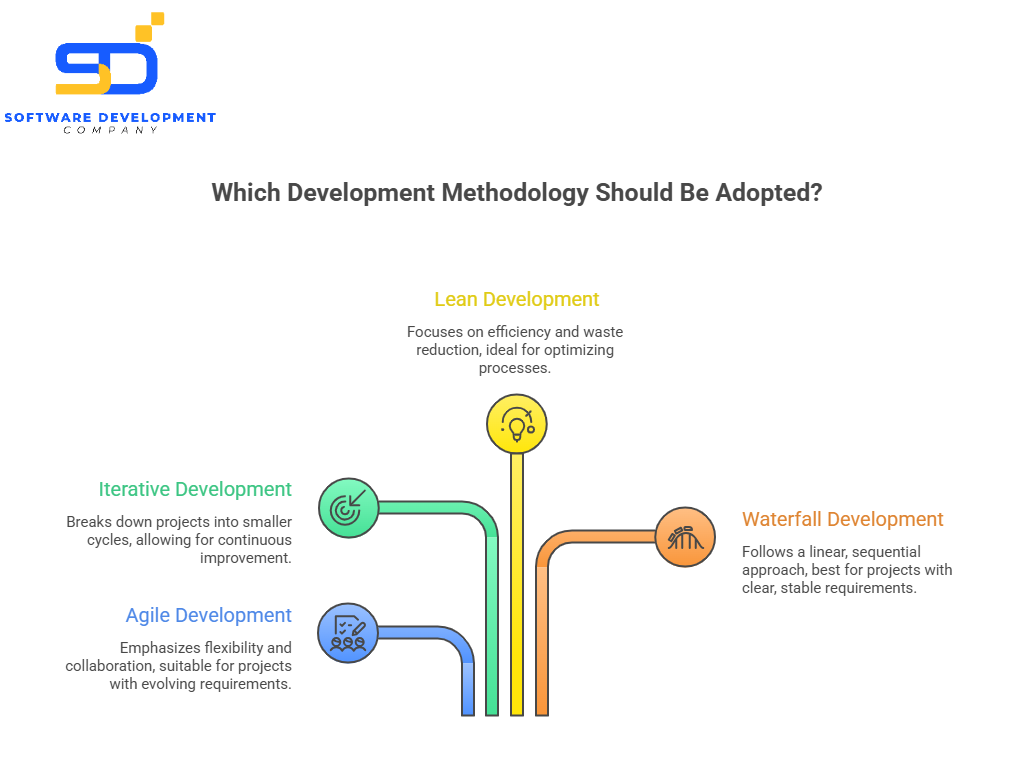
Selecting the best development approach for startups is essential since it directly impacts several process elements, which include timeliness, product quality, total cost and more. The project’s goals and objectives, the resources at your disposal and the degree of flexibility required should all be taken into consideration when selecting a methodology.
Although traditional business models like Waterfall are still in use, specifically for the smaller projects. In contrast, Agile or Lean approaches are preferred for the established enterprises due to their flexibility, quicker delivery cycles and iterative manner with easy collaboration within the team. Moreover, by knowing the advantages and disadvantages of each model, it will be easier for you to make an informed decision.
Moving on with the list of most popular methodologies that most of the organizations prefer for the high-performance and quality product, this includes Agile, Lean, Waterfall, Iterative and so on.
Agile Development
An iterative and flexible approach that is adaptable to change in any phase of the development, Agile development, it works for startups in a way that the larger project is broken into smaller sprints or modules. It also allows the team to continuously build, test, and deliver features while receiving regular client input.
How is it useful for startups?
Faster MVP Launch: By releasing an MVP, Agile enables startups to gather feedback and changes in requirements in the early stage, and it helps in validating the idea as well as the structure of the workflow.
- Adaptability: With the help of an agile development approach, startups can respond to changing market needs and trends efficiently.
- Reduced Development Risks: Incremental development minimizes the risk of building unwanted features.
- Cost Management: Agile helps manage resources more effectively and helps develop an innovative platform without breaking the bank.
- User-Centric Products: Products are built based on real user feedback.
When to use Agile:
Agile is best used when project requirements are expected to change with the rapid evolution of the market trends and user needs, quick time-to-market is important, continuous client or stakeholder collaboration is possible, and the product needs ongoing improvements and scalability.
Iterative Development
An approach that expands on the fundamental idea of Agile is called Iterative Development. According to this approach, the design, development, and testing phases of the software development process for startups are repeated multiple times, with each cycle or iteration improving upon the previous one. Iterative development examines repeated cycles, which may be larger than Agile and focuses on sprints. This is the main distinction between the two approaches.
Why does iterative cycle work?
- Continuous Improvement: This approach makes it easier for the developers to work on the app’s features and functionalities at any stage of the development and take into account user feedback. This guarantees the change in the process during the development of custom software for startups.
- Error Reduction: Moreover, bugs and errors are found and fixed at the earliest stage of development, which could become a bigger problem for the platform later on. This saves time, effort and most of all, the additional charges that might give you a heart attack later.
- Chance Management: By continuously evaluating and refining the project in smaller portions rather than working on a single monolithic build, iterative development, like Agile, helps lower the chance of failure.
Lean Development
If anyone is looking for project development with a limited budget, then the lean development approach is a suitable one for your project. Why? Because it focuses on eliminating non-essential activities and maximizing value. It also works well where you need to validate business business ideas quickly and make changes while learning from feedback from the clients. Lean also helps teams deliver only what customers truly need, with efficient workflows.
Difference Between Agile and Lean Development
| Agile Development | Lean Development |
| Deliver working software in short iterations | Eliminate waste and maximize customer value |
| Iterative and incremental development | Continuous improvement and efficiency |
| Adapt quickly to changing requirements | Build only what is needed with minimum resources |
| Flexible and adaptive planning | Strategic, value-driven planning |
| High–frequency feedback in every sprint | High–frequency feedback in every sprint |
| Time-boxed sprints (e.g., Scrum cycles) | Continuous flow of value |
| Changes are welcomed, even late in development | Changes are evaluated based on value and waste reduction |
| Cross-functional, collaborative teams | Empowered teams focused on efficiency |
| Working software, velocity, customer satisfaction | Reduced waste, faster delivery, optimized process |
| Requirements change frequently | Cost, efficiency, and process optimization are critical |
Waterfall Development
A traditional and linear software development methodology where each phase is completed before moving to the next, with little to no overlap between stages.
Why can the waterfall still be useful
- It works smoothly when the project scope is clear, and changes are unlikely.
- Ideal for industries that require detailed records, approvals, and compliance.
- Clear phases, timelines, and milestones make budgeting, tracking, and resource allocation straightforward.
When to use the Waterfall model
- Use it for projects where the scope, features and goals are fully defined and are unlikely to change.
- It is suitable for regulated industries like healthcare, banking and government projects.
- Best for small projects using well-known technology.
What Software Development Process Should You Choose?
Choosing the right software development process has a huge impact on your project that can literally make or break it, so it is crucial to make an informed decision when it comes to the software development. It begins with the initial phase, which is to understand the goals, team, timeline, budget and flexibility needs.
- Agile is the favorite among startups and modern software teams, which enables faster delivery, adapt on the fly, and continuous improvement based on real feedback.
- Lean development is perfect for quickly validating business business ideas without burning resources.
- Iterative approaches shine in complex projects that benefit from gradual improvements.
- Waterfall still has its place for projects with fixed requirements and strict scopes.
Wondering which could be the real secret to success among these? Pick the methodology that fits your team’s strengths, matches your project complexity and keeps pace with your market, so you can stay competitive, upgraded and on-time while scaling with confidence. Here’s a breakdown of each type of process:
| Preference by Top Development Companies | Why It’s Preferred | Best Use Case | |
| Agile | ⭐⭐⭐⭐⭐ (Most Preferred) | Fast delivery, continuous feedback, flexibility, client involvement, quick adaptation to market changes | Startups, SaaS products, evolving requirements, long-term scalable products |
| Iterative Approach | ⭐⭐⭐⭐ | Gradual improvement, early testing, reduced risk, visible progress in cycles | Complex systems, products that need continuous refinement |
| Lean Development | ⭐⭐⭐⭐ | Minimum waste, rapid validation, cost efficiency, faster MVP launch | Startups, MVP development, idea validation with limited budget |
| Waterfall | ⭐⭐ | Clear structure, fixed scope, predictable timeline and cost | Projects with well-defined, stable requirements (e.g., government, healthcare, enterprise compliance systems) |
Source: https://www.nexrage.com/blogs/software-methodologies-agile-vs-waterfall-vs-lean
How To Choose The Best Tech Stack
The following are the steps you can follow to make the right choice for your product tech stack:
- Understand Project Requirements: Determine if your software is a web app, mobile app, or complex system and identify essential features like real-time updates, AI integration, or secure authentication.
- Evaluate Team Expertise: Use technologies your team is familiar with to speed up development and reduce errors; unfamiliar stacks may require extra training or hiring.
- Consider Scalability and Performance: Choose a stack that can grow with your users and handle high traffic without performance issues.
- Balance Budget and Timeline: Weigh the cost of open-source versus licensed tools and factor in development speed versus overall expenses.
- Check Community Support: Popular languages and frameworks with strong communities make troubleshooting easier and future-proof your product.
- Align With Project Type: Flexible stacks like Node.js + React or Django suit startups and MVPs, while Java or .NET are ideal for enterprise solutions; Swift, Kotlin, or cross-platform frameworks work best for mobile apps.
- Plan for Maintenance and Updates: Ensure the stack allows smooth updates, easy integrations, and long-term scalability to keep your product efficient and cost-effective.
How Does All This Impact The Cost Of Software Development?
If you are an entrepreneur starting up your business, understanding the cost of developing software is crucial. Developing software requires more than just technical expertise as well as numerous factors that need consideration, ranging from the team you hire to the design and technology you choose for your product development. Here we’ll break down the elements that impact your software’s development costs and provide insight into how you can budget effectively.
Scope Of The Project
The size of the project matters when it comes to the budget. Moreover, the cost of developing your product will increase with its complexity. You can have a better understanding of the complexity is categorized as basic or simple, medium and complex or advanced platforms.
- Simple Software: This software comes with basic functionality and minimal features, such as a to-do list, a weather app or a calculator. They typically don’t require a backend or advanced functionality, and could cost ranging from $40,000 – $100,000.
- Medium-Complexity Software: This software requires more advanced features, including user authentication, integration with third-party services, and a basic backend. With the advanced functionality like chat and social network connectivity, or advanced services like based on location, this might take the development cost to $100,000 – $200,000.
- Complex Software: This software takes a significant development time and requires advanced requirements of features and a streamlined backend. They include products with features like real-time syncing, in-app purchases, geolocation, multi-user support, and integration with AI or machine learning. With the advanced integrations and connectivities, the development of the complex software could cost a range around $200,000 – $500,000.
Understanding these levels of complexity will help you budget more effectively. While simple platforms take a short period of time to be developed and most of all it is quite affordable as well. whereas the complex products will require larger teams and longer timelines to be properly implemented and tested.
| Software Type | Estimated Development Cost |
| Simple Software | $40,000 – $100,000 |
| Medium-Complexity Software | $100,000 – $200,000 |
| Complex Software | $200,000 – $500,000 |
Moreover, there are several other factors on which the cost of the software development depends, which we have collected for you in the same table, so you can have a clear picture as a startup.
Team and Resource Costs
| Factor | Typical Cost / Rate | Key Considerations |
| In-House Team | $50,000 – $150,000 per year | Higher wages in regions like the US or Western Europe. Includes developers, designers, and PMs. |
| Freelancers | $25 – $100 per hour | Provides flexibility, but may require hiring multiple specialists for different needs. |
| Outsourcing | $15 – $50 per hour | Can significantly reduce costs depending on the level of expertise and experience. |
| Software Design | $5,000 – $50,000 | Covers UI/UX and product usability; more sophistication leads to higher costs. |
Technical and Ongoing Expenses
| Category | Component | Estimated Cost / Impact |
| Tech Stack | Backend Development | $10,000 – $100,000 depending on system complexity. |
| Third-party Integrations | Increases costs due to integration labor and service fees (e.g., payment gateways, APIs). | |
| Testing/QA | Manual Testing | $5,000 – $30,000 based on product complexity. |
| Automated Testing | A few thousand dollars for initial setup; more cost-effective long-term. | |
| Post-Launch | Maintenance/Updates | 15-20% of the initial development cost annually. |
| Contingency Budget | 10-20% of the total budget for unforeseen changes. |
What Is The Future Of Custom Software Development For Startups
The future of custom software development for startups is all about speed, flexibility and innovation. There are methodologies like Agile and Lean that help startups to take advantage of the latest technologies like AI, machine learning, and low-code platforms and adopt cloud-based architectures as well. With a focus on customer-centric development and strong security, startups can quickly turn business ideas into exceptional products.
Successful startup software development isn’t just about coding but having a strategic approach, smart tech choices and a user-focused design that will take your software to the next level. By combining methodologies, scalable tech stacks and continuous iteration, startups can turn business ideas into revenue-generating products that grow with the market. If you want to develop the best software for your startup or business then contact us today!